
LAPO: Internalizing Reasoning Efficiency via Length-Adaptive Policy Optimization
Published in EMNLP 2026 (Findings), 2025
Efficient ReasoningLength ControlReinforcement Learning
TL;DR. Two-stage RL that lets models internalize an appropriate reasoning length for each problem.
Abstract
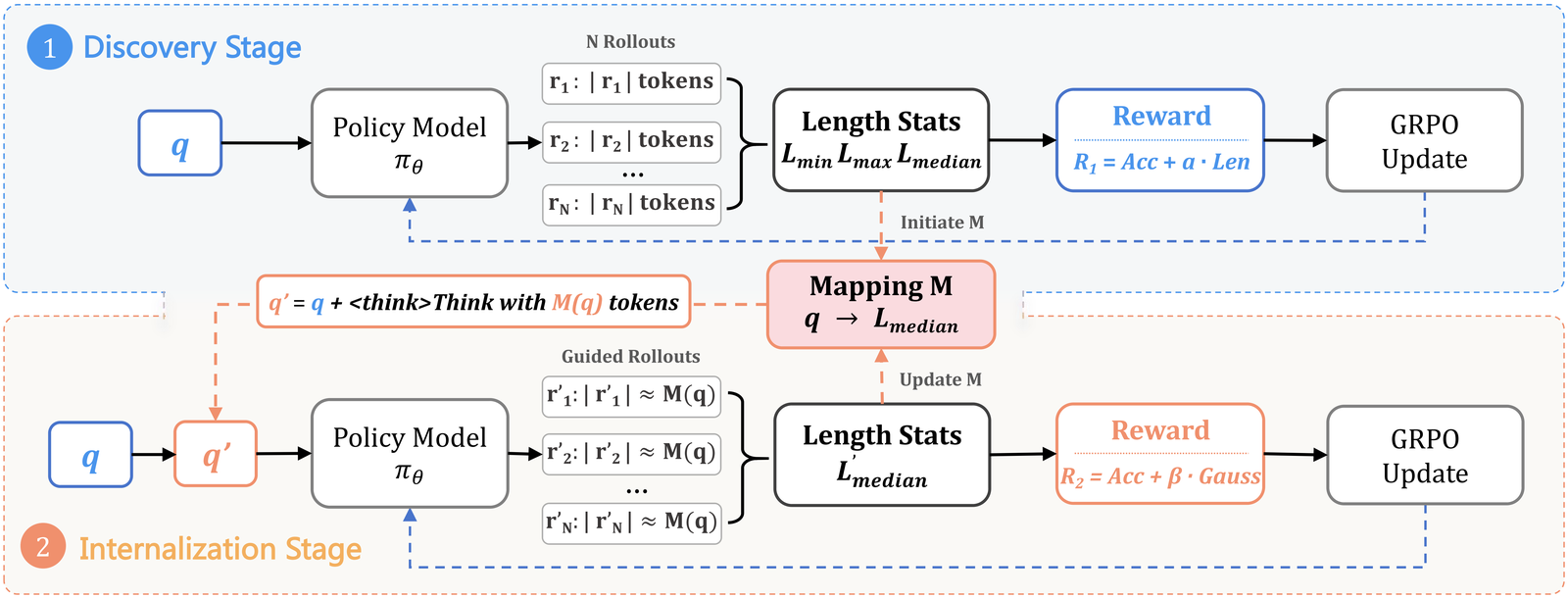
Large reasoning models have achieved remarkable performance through extended chain-of-thought sequences, yet this computational freedom leads to excessive token generation even for simple problems. We present Length-Adaptive Policy Optimization (LAPO), a novel framework that transforms reasoning length control from an external constraint into an intrinsic model capability. Unlike existing approaches that impose rigid limits or rely on post-hoc interventions, LAPO enables models to internalize an understanding of appropriate reasoning depth through a two-stage reinforcement learning process. In the first stage, models learn natural reasoning patterns by discovering the statistical distribution of successful solution lengths. The second stage leverages these patterns as meta-cognitive guidance, embedding them directly within the model’s reasoning context to ensure inference-time flexibility. Experiments on mathematical reasoning benchmarks demonstrate that LAPO reduces token usage by up to 40.9% while improving accuracy by 2.3%. Our analysis reveals that models trained with LAPO develop emergent abilities to allocate computational resources based on problem complexity, achieving efficient reasoning without sacrificing quality.